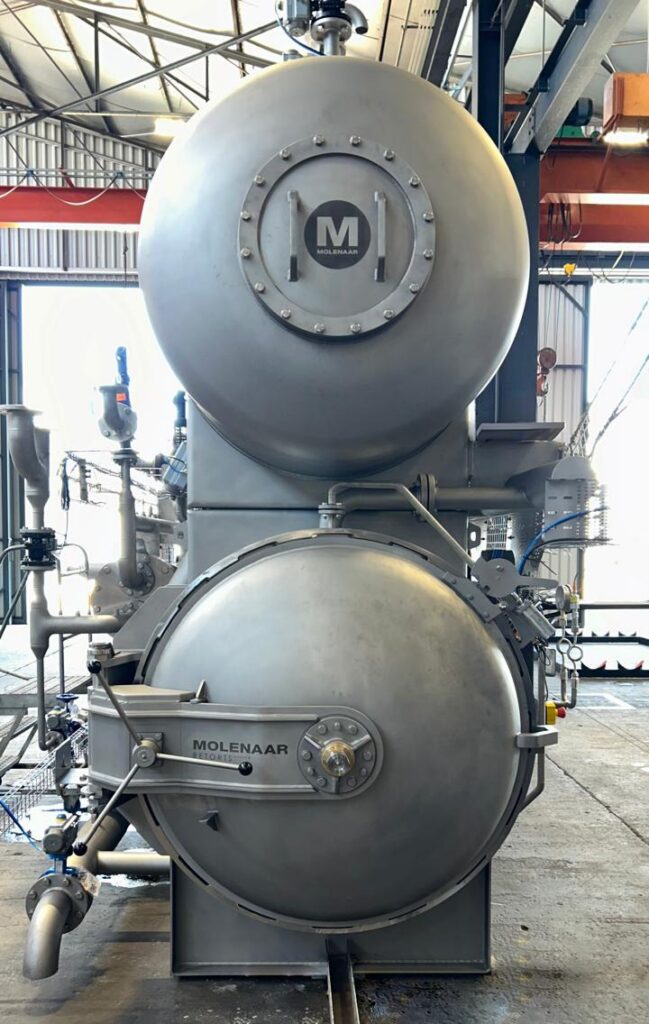
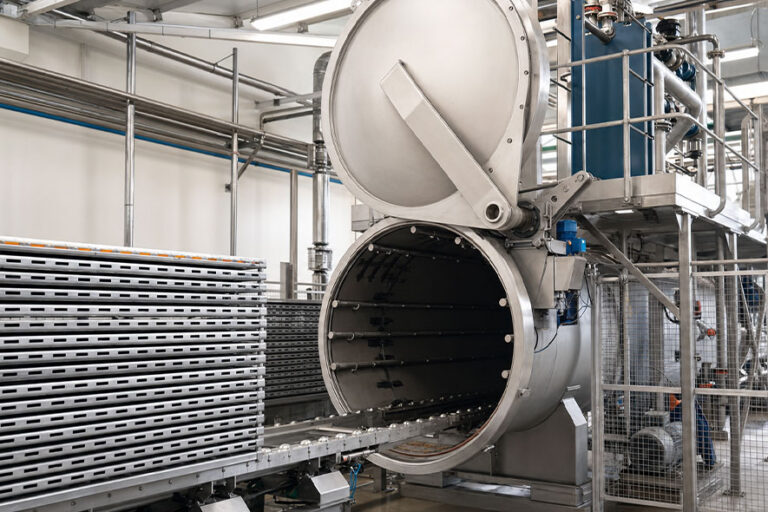
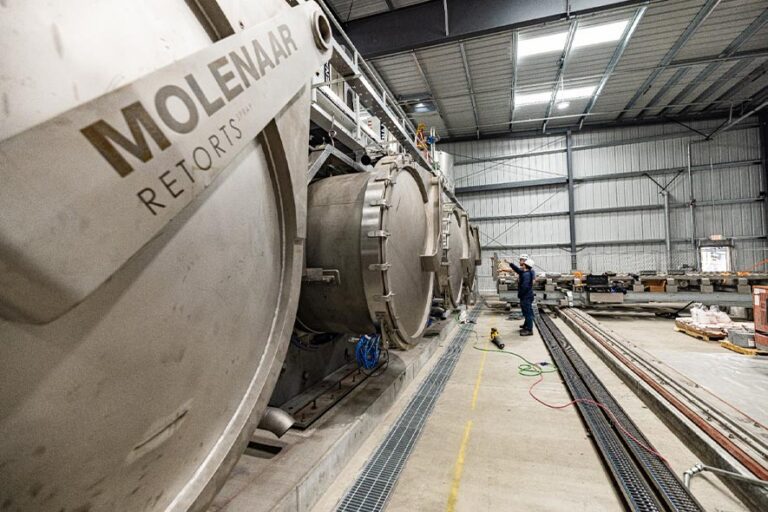
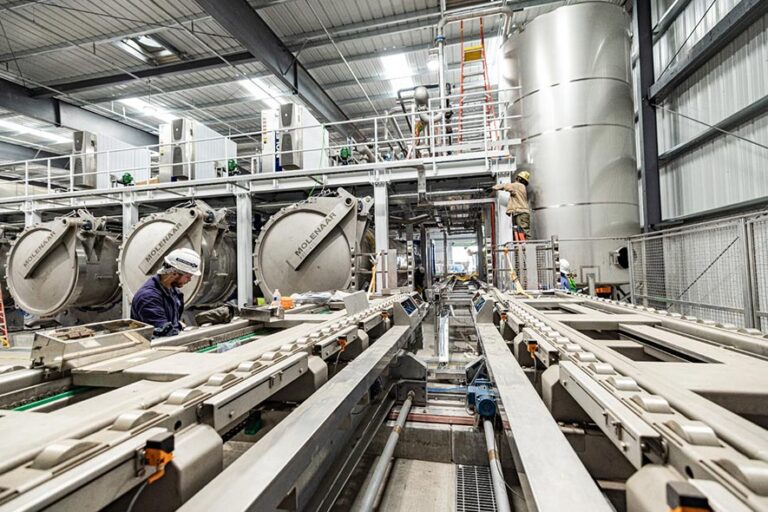
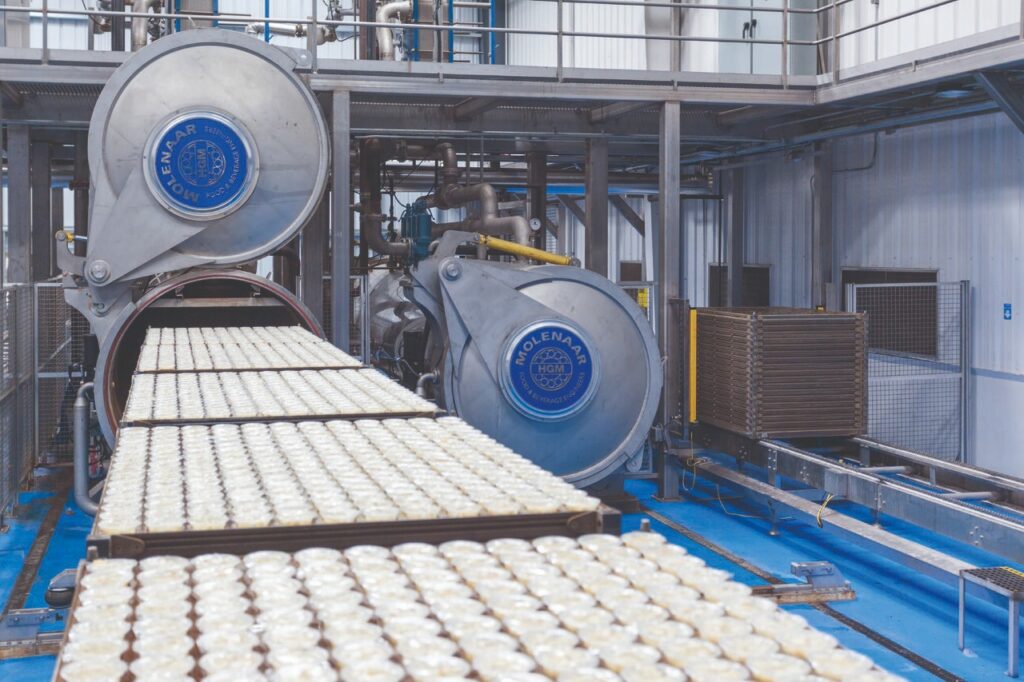
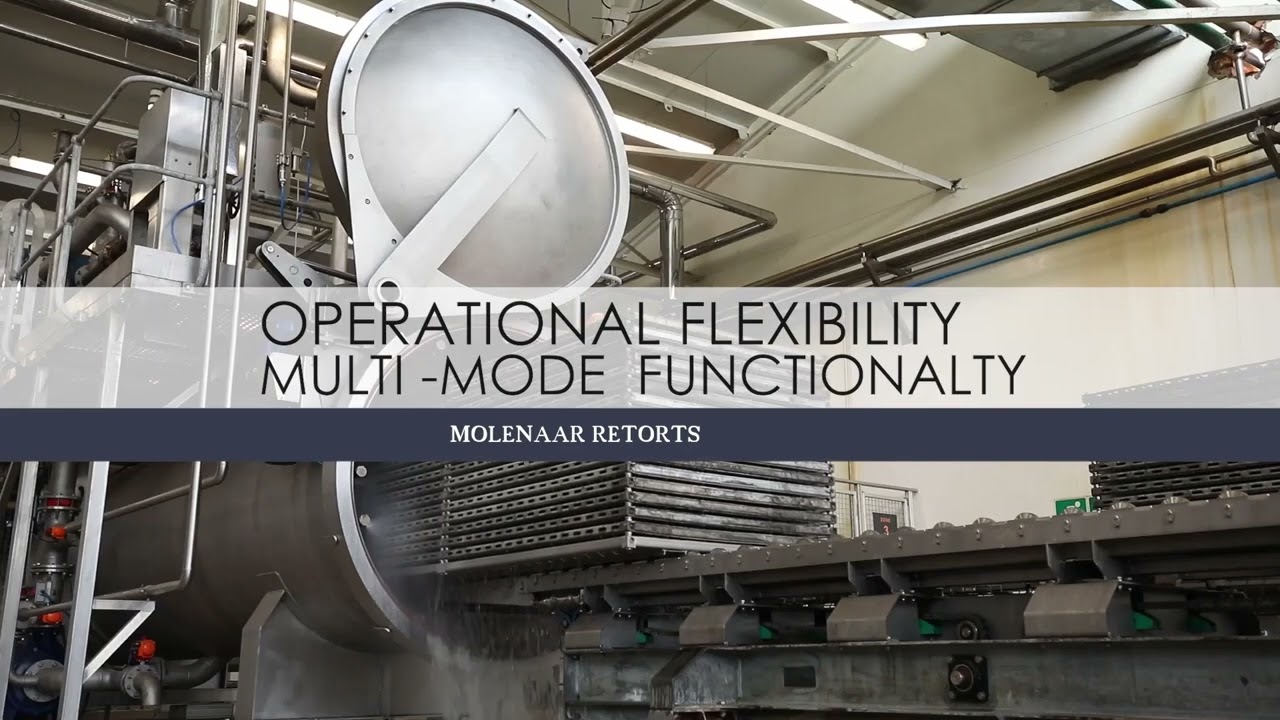
Molenaar retorts (also referred to as autoclaves) are technologically advanced pressure vessels designed for in-container thermal processing – delivering food safety, product quality and operational efficiency across global markets. Our range includes steam, water-spray and full water-immersion systems, each engineered for precise temperature control and uniform heat distribution, plus hybrid systems that adapt to packaging-format changes.
The Basics
What is a Retort?
In food processing, a retort is a pressurised vessel used to thermally process sealed products at temperatures above boiling point, ensuring commercial sterility – eliminating harmful microorganisms and extending shelf life. Processing parameters (temperature, time and pressure) are governed by product lethality requirements: higher temperatures increase the rate of microbial destruction, enhancing both product safety and line efficiency. Retorts process products in:
Cans
Glass jars and bottles
Flexible pouches
Suitable plastic containers
Heating Technologies
Retort Heating Technologies
Steam Retorts
A highly efficient heating medium delivering rapid heat transfer through condensation. Ideal for metal cans – fast come-up times and uniform temperature distribution.
Water Spray Retorts
Spray nozzles distribute a fine mist of superheated water in a tight pattern for uniform heat distribution. Energy-efficient and suitable for plastics, glass and pouches.
Water Immersion Retorts
Full immersion submerges products in heated water under controlled pressure – gentle yet effective, ideal for delicate packaging and heat-sensitive products. Configurable as single- or multi-mode.
Process Modes
Static, Oscillating & Rotary
Static
Ideal for solid or viscous products where heat transfer occurs primarily through conduction.
Oscillating
Gentle agitation improves heat penetration in flexible packaging such as pouches and trays.
Rotary (End-over-End)
Continuous rotation enhances heat transfer through forced convection, reducing processing time and improving product quality.
Agitation can significantly improve efficiency, reduce energy consumption and preserve nutritional value.
Automation
Automation & Handling Systems
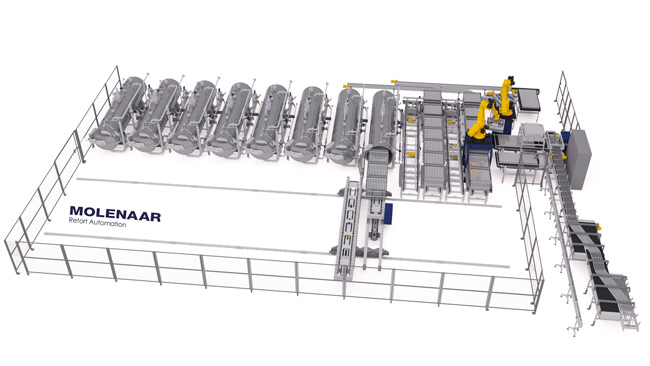
Molenaar offers a full range of automation to complement its retort systems – improving operational efficiency and product consistency, and tailored to existing lines or future expansion plans.
Semi-Automatic Basket Loading
Mechanises a repetitive part of the operation while retaining manual retort loading.
Simplified operations
Reduced container damage and product losses
Can be automated at a later date
Fully Automated Robotic Loading
Automatic basket loading via traditional sweep-type machines or robotic systems.
Automated operation
Reliable
Small footprint
Shuttle Loading Systems
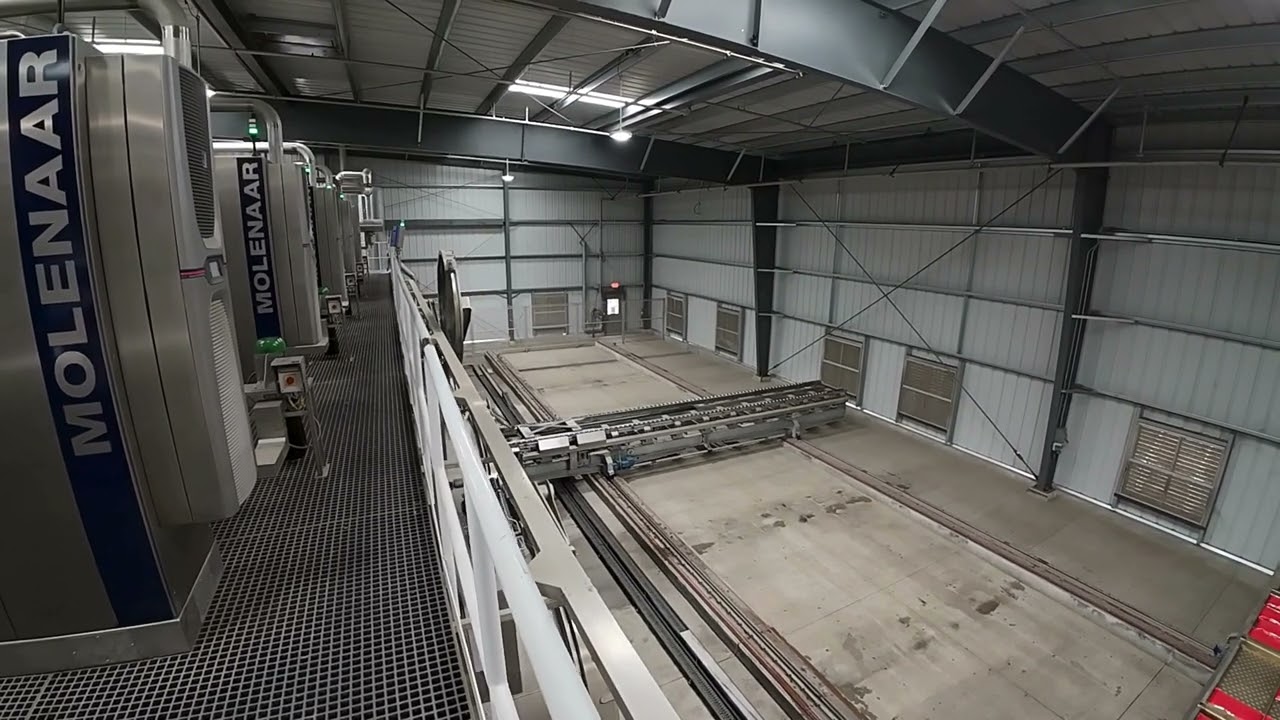
Fully automatic retort loading including door mechanisation, automatic shuttles and retort loading/unloading. Optionally automation-ready for future upgrades.
Efficient
Safe
Reliable
Product security
Process Recording
Paperless option - export process data to USB or WiFi - or a circular paper-chart recorder option.
Basket Tracking System
Tracks baskets throughout the retorting process - from loading into the retort to unloading - with relevant quality-control information.
Sustainability
Energy Efficiency & Sustainability
Recovered heat and water can be reused across cycles, improving sustainability without compromising performance.
Molenaar retorts are designed and manufactured to international pressure-vessel codes and standards, ensuring reliability, safety and acceptance across global markets:
ASME Section VIII Div.1 2019 ed. – USA
PED 2014/68/EU – Europe
RSA/CI/OHSA 8.1-17-W – South Africa
Why Molenaar
Why Choose Molenaar Retorts?
Proven global expertise in thermal processing
Exceptional heat distribution and process control
Flexible configurations for multiple product types
Automation-ready systems
Strong after-sales support and technical expertise
In food processing, there is no functional difference between a retort and an autoclave. Both refer to pressurised vessels used for thermal processing of sealed products.
Retorts, also known as autoclaves, are used to sterilize packaged food. They apply controlled heat and pressure to eliminate harmful microorganisms, ensuring food safety and extending shelf life.
A wide range of packaged products, including canned foods, glass jars and bottles, flexible pouches and suitable plastic containers. These systems suit products such as sauces, dairy products and pet food.
Sterilization uses higher temperatures (typically 110°C to 135°C) to destroy heat-resistant bacteria and spores in low-acid foods. Pasteurization uses lower temperatures (80°C to 105°C) and suits acidic products where full sterilization is not required.
Common types include steam retorts, water spray retorts, water immersion retorts and steam-air retorts. Each uses a different heating method, selected based on packaging type, product characteristics and processing requirements.